Quick Answer
Your shiny new condensing boiler probably isn't condensing. And if it's not condensing, it's just an expensive non-condensing boiler with a stainless steel heat exchanger. The secret to making condensing boilers actually work is all about return water temperature — get that below 130°F and you're in business. But the piping, the controls, and the reset strategy all have to be right, or you're just burning money with a fancier flame.
The Sales Pitch vs. Reality
Every boiler rep in the country will tell you their condensing boiler runs at 95-98% efficiency. And they're not lying — it can. Under perfect lab conditions. With return water at 80°F. In a test chamber that doesn't exist in any building you'll ever work in.
Here's what actually happens: the boiler gets installed, the piping is done the same way it's always been done, the controls are set to a fixed 180°F supply temperature because "that's what we've always run," and that beautiful condensing boiler never condenses a single day in its life. It's running at maybe 85% efficiency — which is fine, but you could've gotten that from a boiler that costs half as much.
I've walked into so many mechanical rooms where the building owner is bragging about their new high-efficiency boilers, and I look at the flue pipe and it's bone dry. No condensate. That means no condensing. That means you paid a premium for nothing.
How Condensing Actually Works
Here's the deal, and it's not complicated. When you burn natural gas, one of the byproducts is water vapor. In a traditional boiler, that water vapor goes up the flue as steam — and takes a bunch of heat energy with it. That's called latent heat, and it's about 10% of the total energy in the fuel.
A condensing boiler has a secondary heat exchanger (or a really big primary one) that cools the flue gases enough to turn that water vapor back into liquid water. When it condenses, it releases that latent heat back into the water. That's where the extra efficiency comes from.
But here's the catch: the flue gases will only condense if the return water temperature is low enough to cool them below the dew point. For natural gas, that dew point is around 130°F. So if your return water is coming back at 160°F — which it will be if you're running a fixed 180°F supply with a 20°F delta-T — those flue gases aren't condensing. Period.
The Piping Problem
This is where it gets ugly. I can't tell you how many times I've seen a beautiful new condensing boiler plant with piping that completely defeats the purpose.
Problem #1: The bypass that kills you. If you've got a bypass valve or a primary-secondary loop that's allowing hot supply water to mix with the return water before it hits the boiler, your return water temperature goes up. Way up. I've seen systems where the return water was 165°F because of a wide-open bypass. At that temperature, you're not condensing anything. You're just making expensive hot water.
Problem #2: The primary-secondary tees are too far apart. Manufacturers say 12 inches max between the tees. I've seen them 4 feet apart. At that point, you don't have hydraulic separation — you have a mixing zone. Hot supply water bleeds into the return, and your boiler never sees cold enough water to condense.
Problem #3: Nobody thought about the expansion tank location. I know, it sounds like a small thing. But a mislocated expansion tank causes pressure problems, which causes air problems, which causes flow problems, which causes your delta-T to collapse, which means — you guessed it — high return water temperatures. It's all connected.
The Control Strategy That Actually Works
The single biggest thing you can do to make a condensing boiler earn its keep is supply temperature reset. This means you lower the supply water temperature when the outdoor temperature is mild. On a 50°F day, you don't need 180°F water. You might only need 120°F. And when you're supplying 120°F water, your return water is coming back at maybe 100°F. Now you're condensing. Now you're getting that 95% efficiency.
Here's a simple reset schedule that works for most commercial buildings:
- At 0°F outdoor: supply at 180°F
- At 60°F outdoor: supply at 100°F
- Linear interpolation in between
The beauty is that most of the heating season, outdoor temps are between 30-50°F. That means most of the time, your supply temp is low enough to condense. That's where the real savings are — not on the coldest day of the year, but on all the mild days.
But what I see constantly: the reset schedule gets programmed during commissioning, and then the first time a tenant complains about being cold, someone overrides it to a fixed 180°F. And it stays there. Forever. I've found overrides that were three years old. Three years of running a condensing boiler at non-condensing temperatures because someone was cold one Tuesday in January.
The Condensate Nobody Plans For
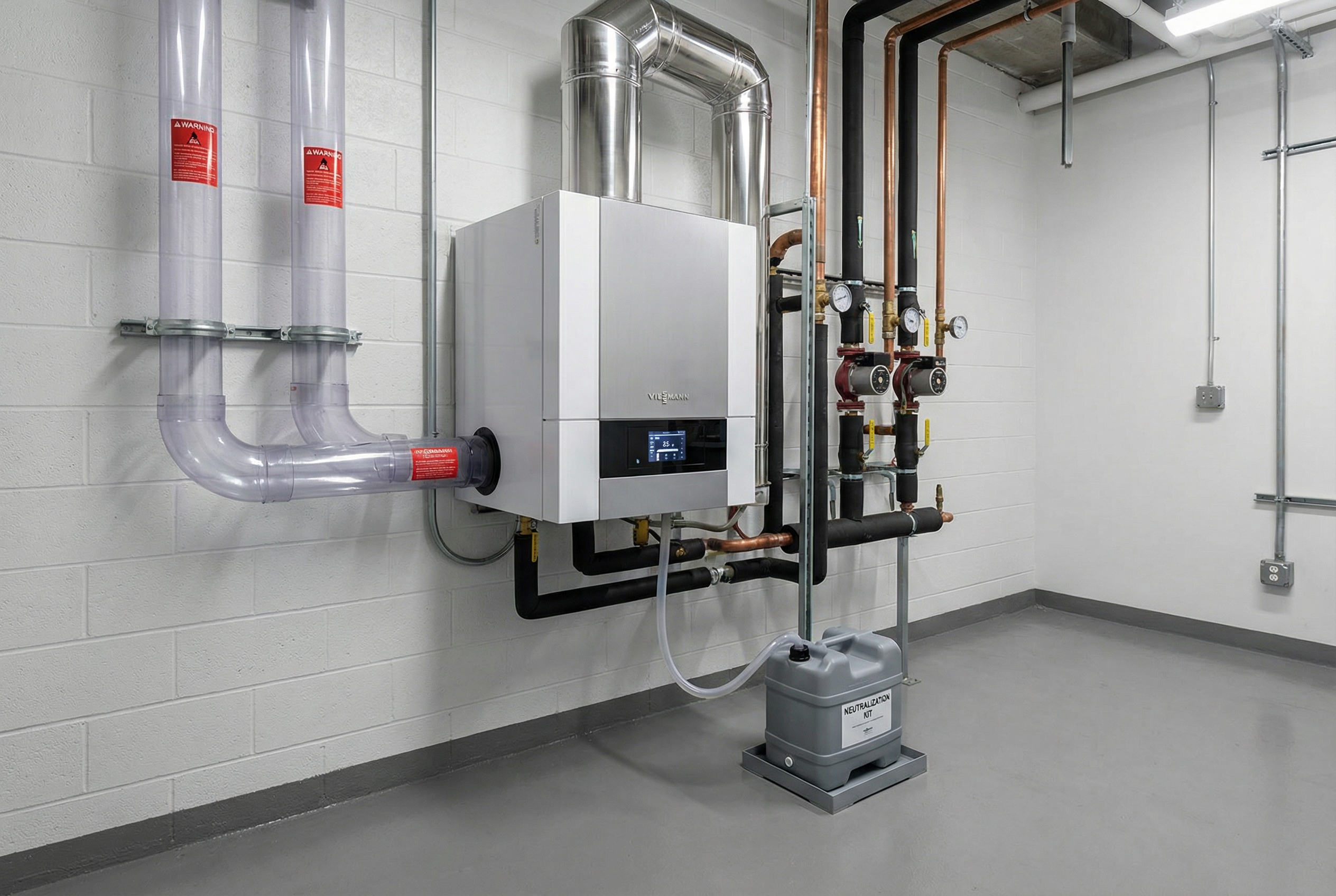
When your boiler actually condenses — and I hope after reading this, yours will — it produces condensate. And that condensate is acidic. We're talking pH 3-5. That's about as acidic as orange juice.
You need:
- A condensate neutralizer (a tank with limestone chips)
- Proper drainage that won't freeze (this is a big one in the Northeast)
- Stainless steel or PVC drain piping — not copper, not steel
I had a job where the condensate drain ran through an exterior wall and froze solid every winter. The boiler would shut down on a condensate backup fault, and the building would go cold. Every. Single. Winter. For three years before they called us. The fix was a $200 heat trace cable. Three years of emergency calls and cold buildings because nobody thought about where the condensate drain went.
Turndown Ratio: The Unsung Hero
Here's something the sales reps actually should be talking about more: turndown ratio. A boiler with a 20:1 or 25:1 turndown can modulate down to 4-5% of its maximum firing rate. That means on a mild day, instead of cycling on and off every few minutes, it just purrs along at low fire.
Why does this matter? Every time a boiler cycles, it goes through a pre-purge and post-purge that pushes cold air through the heat exchanger. That's wasted energy. A boiler that can modulate down to match the load instead of cycling is dramatically more efficient over a season.
I always tell building owners: the nameplate efficiency matters, but the turndown ratio matters more. A 92% efficient boiler with a 25:1 turndown will use less gas over a season than a 96% efficient boiler with a 5:1 turndown. Every time.
What I Check on Every Boiler Job
When I walk into a mechanical room with condensing boilers, here's my checklist:
- Is the flue pipe wet? If there's no condensate, it's not condensing. Simple as that.
- What's the return water temperature? If it's above 130°F, we have a problem.
- Is there a reset schedule? If the supply temp is fixed, that's the first thing to fix.
- Are there overrides? Check the BAS. There are almost certainly overrides that have been there for years.
- How's the piping? Look for bypasses, check the primary-secondary tees, find the expansion tank.
- What's the cycling rate? If the boiler is cycling more than 3 times per hour, something's wrong — either it's oversized, the turndown isn't enough, or there's a control issue.
- Check the condensate drain. Make sure it's not frozen, not clogged, and has a neutralizer.
The Bottom Line
Condensing boilers are genuinely great technology. When they're installed right, piped right, and controlled right, they save real money. I've seen 20-30% gas savings on buildings that went from fixed-temperature non-condensing to properly reset condensing plants.
But "properly" is doing a lot of heavy lifting in that sentence. The boiler is maybe 20% of the equation. The piping is 30%. The controls are 50%. Get the controls wrong and it doesn't matter how good the boiler is.
So the next time someone tries to sell you a condensing boiler by pointing at the efficiency number on the spec sheet, ask them one question: "What's your plan to keep the return water below 130°F?" If they can't answer that, they're selling you a really expensive non-condensing boiler.
And if you're a tech reading this and you've got condensing boilers on your route — go check the flue pipes tomorrow. If they're dry, you've got work to do. The good news is, it's usually a controls fix, not a piping fix. Reset that supply temperature, kill those overrides, and let the boiler do what it was designed to do.
Frequently Asked Questions
Why isn't my condensing boiler saving money?
Most condensing boilers never actually condense because the return water temperature is too high. You need return water below 130F for natural gas boilers to condense.
What return water temperature do condensing boilers need?
For natural gas condensing boilers, the return water temperature needs to be below approximately 130F for the flue gases to reach their dew point and condense.