Quick Answer
When you're picking a new chiller, don't get hypnotized by the full-load efficiency numbers the sales guy is waving in your face. The real story is in the part-load value (IPLV), because that’s where your machine is going to live 90% of the time. For big jobs, a water-cooled centrifugal is your best bet for efficiency, but only if you’re ready to stay on top of your cooling tower and water treatment like it’s a second job. For simpler setups, a modern air-cooled scroll or screw machine can be a great workhorse, especially now that they’re getting loaded up with the new, less-terrible refrigerants.
The Setup
I had a sales rep in my office the other day, sharp suit, shiny shoes, the whole nine yards. He was pushing this new air-cooled unit, talking about its amazing full-load kW/ton like it was the greatest thing since sliced bread. He had charts, he had graphs, he had a whole presentation that must have cost a fortune.
I let him finish his song and dance, and then I asked him one question: "What's the IPLV?"
He blinked. It was like I’d asked him to solve a calculus problem. He had to shuffle through his papers for five minutes to find the number. Here’s the thing: that number, the Integrated Part-Load Value, is the only one that really matters in the real world. Your plant isn't running at 100% on the hottest day of the year all year long. It's running at 50, 60, 70% load most of the time. And that’s where efficiency is either made or lost.
What You're Seeing (The Symptoms)
You've probably seen the fallout from a bad chiller choice. You get a call to a building and the symptoms are all over the place. The energy bills are through the roof, but the chiller’s nameplate says it’s a high-efficiency model. What gives?
Or you’re in a mechanical room and you hear it—that weird, violent shudder from a big centrifugal machine. It sounds like the whole thing is about to tear itself apart. That’s surge, my friend. It’s a classic sign of a chiller operating way outside of where it wants to be, usually because of a mismatch between the machine and the system.
Then there are the absorption chillers. Great idea on paper, especially if you have "free" steam or waste heat. But in reality? You’re constantly chasing vacuum leaks, and one wrong move with the solution temperature and the whole thing turns into a giant, expensive slushie. We call that crystallization, and it’s a nightmare to fix.
What's Actually Going On (The Technical Side)
Let's break it down. Picking a chiller is really three choices rolled into one.
First, you’ve got the cycle: standard vapor-compression (what 99% of us work on) or absorption. Absorption uses heat instead of a motor, which is a whole different can of worms. Your main enemies are air leaking into the vacuum and the lithium bromide solution crystallizing. It’s a specialized world, and you need to know what you’re getting into.
Second, how are you rejecting the heat? Air-cooled, water-cooled, or evaporative. An air-cooled machine is simple, like the condenser on a residential split system, just a hell of a lot bigger. A water-cooled machine is the efficiency king because it uses a cooling tower. That lets it reject heat at the wet-bulb temperature, which is way lower than the dry-bulb. The catch? Now you own a cooling tower, and you’re a part-time water treatment chemist, battling scale, corrosion, and Legionella.
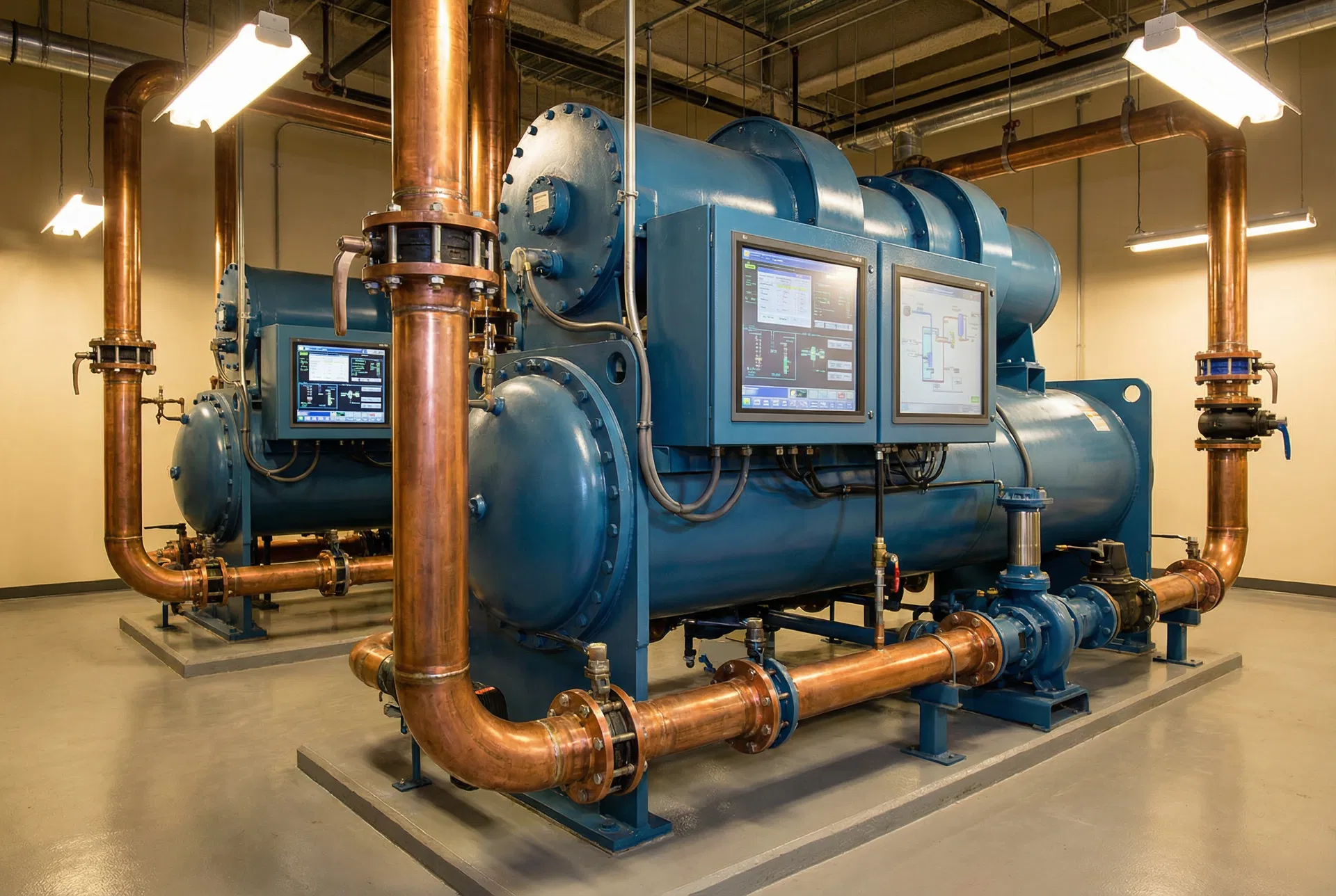
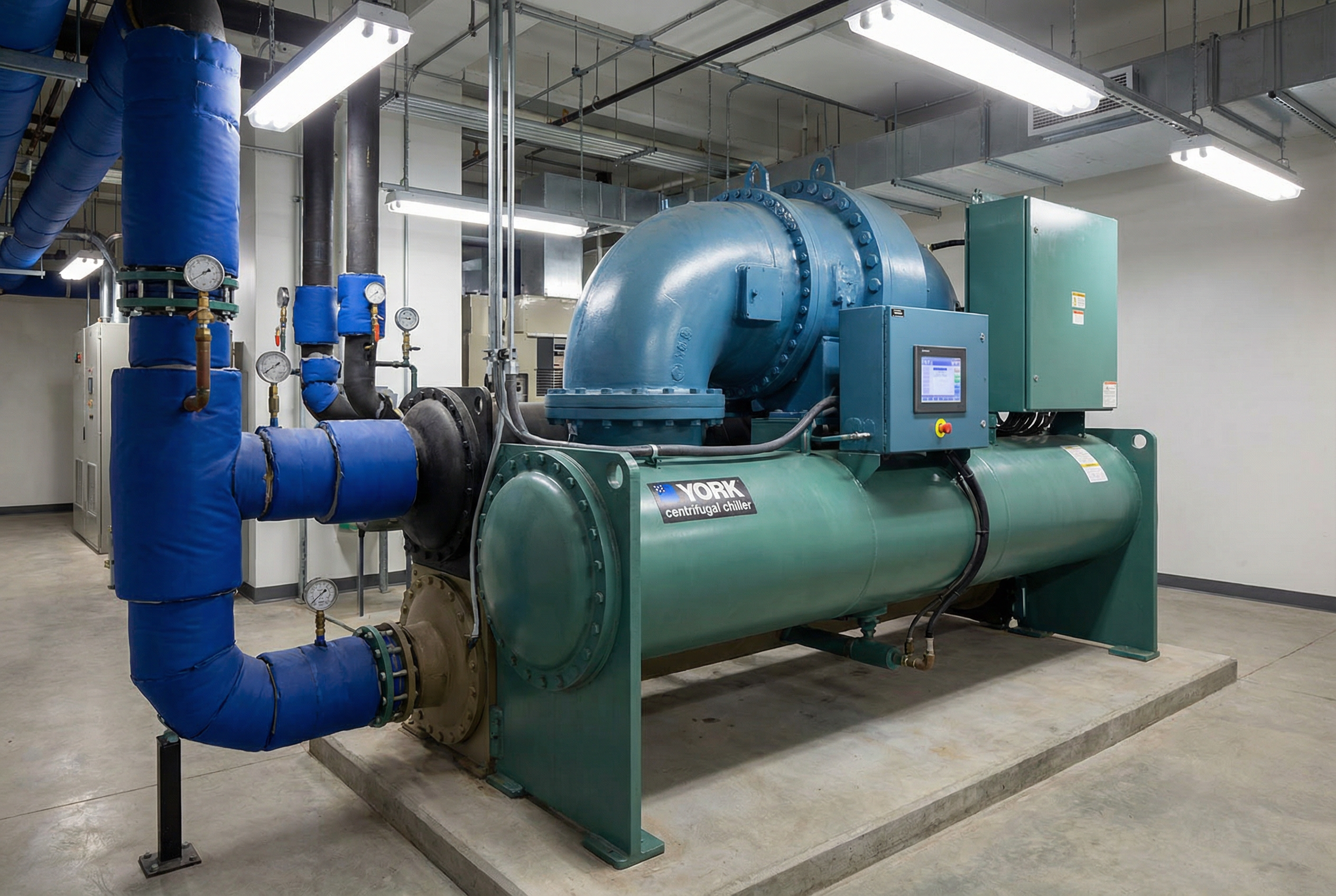
Third, and this is the big one, is the compressor. A centrifugal chiller is like a jet engine; it slings refrigerant around. They are fantastic at part-load, especially with a VFD, but they have a mortal enemy: surge. Too much pressure lift with too little flow, and the refrigerant gas flows backward. It’s violent and can kill a machine. A screw compressor is a positive-displacement machine. It’s a workhorse, but the old-school ones with a slide valve for capacity control get crazy inefficient when they’re unloaded. You’re often better off staging two smaller screws than running one big one at 20%.
And now we have the new oil-free, mag-bearing compressors. No oil to foul up your heat exchangers, which is great. But now you have a whole new set of electronics and controls to worry about. It’s always a trade-off.
What to Check First (Troubleshooting)
So you’re staring at a chiller that’s acting up. Where do you start?
-
High Head Pressure? Check for Dirt. Before you do anything else, look at the condenser. On a water-cooled unit, is the water treatment being done? Pull a head and look in the tubes. Are they scaled up? On an air-cooled unit, are the coils plugged with dirt, cottonwood seeds, or that crap from the roofers next door? A dirty condenser is the #1 cause of high lift and wasted energy. Clean it.
-
Hearing Strange Noises? Think Surge. If a centrifugal is surging, the machine’s own controls are your first clue. They’re designed to prevent it. If it’s happening anyway, you have a system problem. Is your condenser water too hot? Is your chilled water flow too low? The machine is telling you it can’t make the lift you’re asking for.
-
Absorption Chiller Acting Weird? It’s Air or Crystals. If an absorption machine isn’t keeping up, it’s almost always one of two things. Either you have an air leak somewhere in that vacuum vessel, and the purge unit is working overtime, or the solution is starting to crystallize. Check your purge logs and your solution temps. Ask me how I know.
The Numbers That Matter
Forget the marketing slicks. Here are the numbers you, the tech, need to care about.
- IPLV/NPLV: This is your part-load efficiency rating. It’s a weighted average of how the chiller performs at 100%, 75%, 50%, and 25% load. It’s not perfect, but it’s a hell of a lot more realistic than the full-load number.
- GWP (Global Warming Potential): The refrigerant game is changing, fast. We’re moving away from high-GWP stuff like R-410A (GWP of ~2088). The new kids on the block are A2Ls like R-454B (GWP of ~466) and HFOs like R-1233zd (GWP of ~1). They have lower flammability, which means new tools, new safety rules, and new service procedures. You have to know what you’re handling.
- Lift: This is the pressure difference between the evaporator and the condenser. The higher the lift, the harder the compressor has to work. A water-cooled chiller has lower lift because the cooling tower water is colder than the outside air. That’s where the efficiency comes from.
What I've Learned (Field Wisdom)
I’ve seen guys install a top-of-the-line, high-efficiency water-cooled chiller and then treat the cooling tower like a swamp. A year later, the condenser tubes are so fouled that the machine is using 30% more energy than it should. They bought a race car and are driving it with flat tires. The high efficiency on paper means nothing if you don’t do the maintenance.
I also remember a job in a data center. They had these big screw chillers with slide valves. The load was pretty low most of the time, and they had one machine running at about 25% capacity all day long. The operator thought he was saving money by not running the second machine. I showed him the power draw. That one "unloaded" machine was eating more electricity than two machines running at 50% each would have. We changed the staging, and their bills dropped by thousands. Just because a machine can run that low doesn’t mean it should.
And don't even get me started on the "rodeo" of a big centrifugal going into a hard surge. It bucks and shakes the whole mechanical room. It’s the kind of thing that makes you want to run for the door. It’s a sign of a deep problem, and you have to be the one to tame that beast before it costs the customer a couple hundred grand.
The Bottom Line
Here’s the thing. The sales rep isn’t necessarily lying to you, but he’s telling you a story that makes his product look good. Your job is to read between the lines. Look past the shiny full-load number and dig into the part-load performance. Understand the real-world trade-offs between air-cooled and water-cooled.
And most importantly, know that the best chiller in the world is only as good as the system it’s connected to and the maintenance it receives. A well-maintained, properly staged plant of older, "less efficient" chillers will outperform a brand-new, top-of-the-line machine that’s ignored and abused every single time. Trust me on that one.
Frequently Asked Questions
What is the main takeaway from this article?
When choosing a chiller, focus on its part-load efficiency (IPLV) over its full-load rating, as that's where it will run most of the time. Water-cooled centrifugal chillers are the efficiency kings fo