For a long time, I found the communication side of BMS intimidating. I came up more mechanically inclined — turning wrenches, reading gauges, diagnosing refrigerant circuits. BACnet and communication protocols weren't part of my training. I chose to learn it later, and I'm still learning.
What pushed me was that my coworkers understood something I didn't. That bothered me. So I started watching videos, reading books, and asking questions until I could at least speak intelligently about it. You don't need to become an IT expert. You need to understand enough to do your job, communicate with the IT department, and troubleshoot the basics. That's it. And it's more approachable than the controls guys make it sound.
What You're Seeing
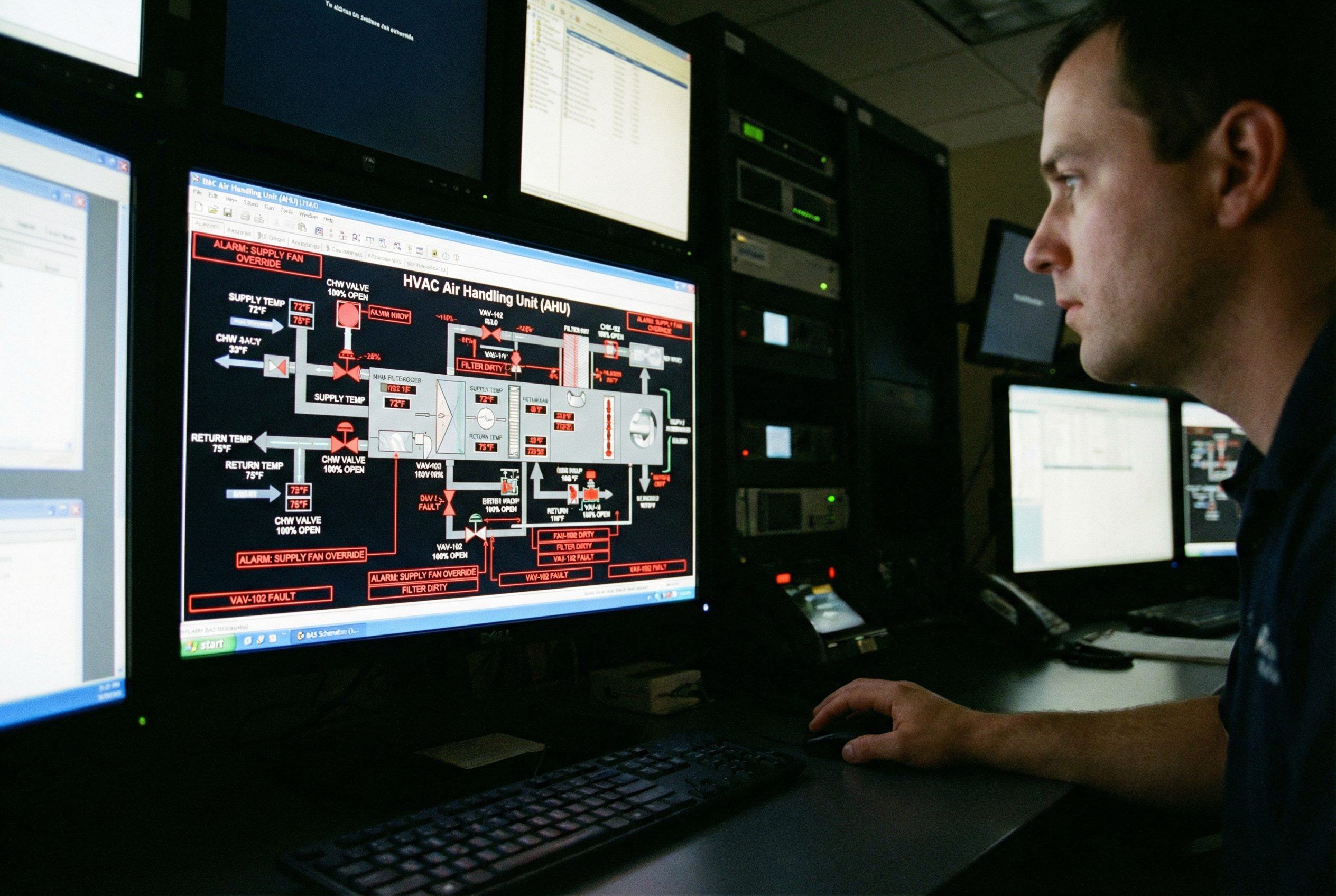
You're standing in front of a BAS workstation and a controller just went offline. Or you're trying to commission a new controller and it won't show up on the network. Or the building engineer says "the BAS is slow" and everyone looks at you like you're supposed to fix it.
These are network problems, and they're becoming more common as BAS systems move from dedicated serial networks to shared IP infrastructure.
What It Usually Means
BACnet has three main transport layers you'll encounter:
BACnet/IP — Runs over standard Ethernet networks, just like your office computer. This is the backbone of modern BAS systems. Controllers, servers, and supervisory devices communicate over the building's IP network (usually on a dedicated VLAN).
BACnet MS/TP — Runs over RS-485 serial wiring. This is the "last mile" connection to field devices — VAV controllers, zone sensors, fan coil units. It's slower but cheaper to wire and perfectly fine for devices that only need to report a temperature every few seconds.
BACnet/SC (Secure Connect) — The newest flavor, running over encrypted WebSocket connections. Designed for cloud connectivity and cybersecurity. You'll start seeing this more as buildings move to cloud-based BAS platforms.
What to Check
For BACnet/IP issues:
Can you ping it? Open a command prompt and ping the controller's IP address. If you get a response, the network connection is good and the problem is likely BACnet configuration. If you don't get a response, it's a network issue — check cables, switches, and IP settings.
Is the IP address correct? Every BACnet/IP device needs a unique IP address. If two devices have the same IP, neither will work reliably. Check for duplicates.
Is it on the right VLAN? Most buildings put BAS traffic on a separate VLAN from corporate IT. If someone plugged a controller into the wrong switch port, it might be on the wrong VLAN and invisible to the BAS network.
For BACnet MS/TP issues:
Check the wiring. MS/TP runs on RS-485, which is a daisy-chain topology. Every device connects to the next in a chain, with termination resistors at each end. If the chain is broken — bad connection, cut wire, missing terminator — devices downstream of the break will go offline.
Check the baud rate. All devices on an MS/TP trunk must be set to the same baud rate. If one device is at 38400 and the rest are at 76800, that device won't communicate. It's like trying to have a conversation when one person is speaking twice as fast.
Check the MAC addresses. Every MS/TP device needs a unique MAC address (0-127) on its trunk. Duplicates cause communication chaos.
Common Mistakes
Plugging BAS devices into the corporate network. IT departments hate this, and for good reason. BAS devices often have minimal security. Keep them on a dedicated VLAN with proper firewall rules between the BAS network and the corporate network.
Not documenting the network. Every BAS network should have a current network diagram showing IP addresses, MAC addresses, device locations, and VLAN assignments. When something goes wrong at 2 AM, you don't want to be guessing.
Ignoring cybersecurity. Default passwords on BAS controllers are a real problem. "admin/admin" is not a security strategy. Change default passwords, disable unused services, and work with IT to keep the BAS network secure. I know it's not glamorous, but a hacked BAS system is a nightmare.
Field Notes
I was commissioning a new floor of VAV boxes in a commercial building — about 30 controllers on a BACnet MS/TP trunk. Got everything wired up, powered on, and... nothing. Zero devices showing up on the network.
Spent an hour checking wiring, verifying MAC addresses, testing continuity. Everything looked perfect. Finally, I noticed that the MS/TP trunk was connected to the network controller through a patch panel, and the patch panel had a crossover in it. Someone had wired pins 1 and 2 to pins 3 and 4 on one of the jacks. The RS-485 signal was getting scrambled at the patch panel.
Fixed the patch panel wiring, all 30 controllers came online instantly. The lesson: when everything looks right but nothing works, check the stuff between the devices, not just the devices themselves.
Also — label your wires. For the love of everything mechanical, label your wires. Future you will thank present you.
Frequently Asked Questions
What is BACnet in HVAC?
BACnet (Building Automation and Control Networks) is the standard communication protocol for building automation systems. It allows controllers, sensors, and software from different manufacturers to communicate on the same network.
What is the difference between BACnet/IP and BACnet MS/TP?
BACnet/IP runs over standard Ethernet networks and is used for backbone communication between major controllers and servers. BACnet MS/TP runs over RS-485 serial wiring and is used for field-level devices like VAV controllers and zone sensors. MS/TP is slower but cheaper to install.