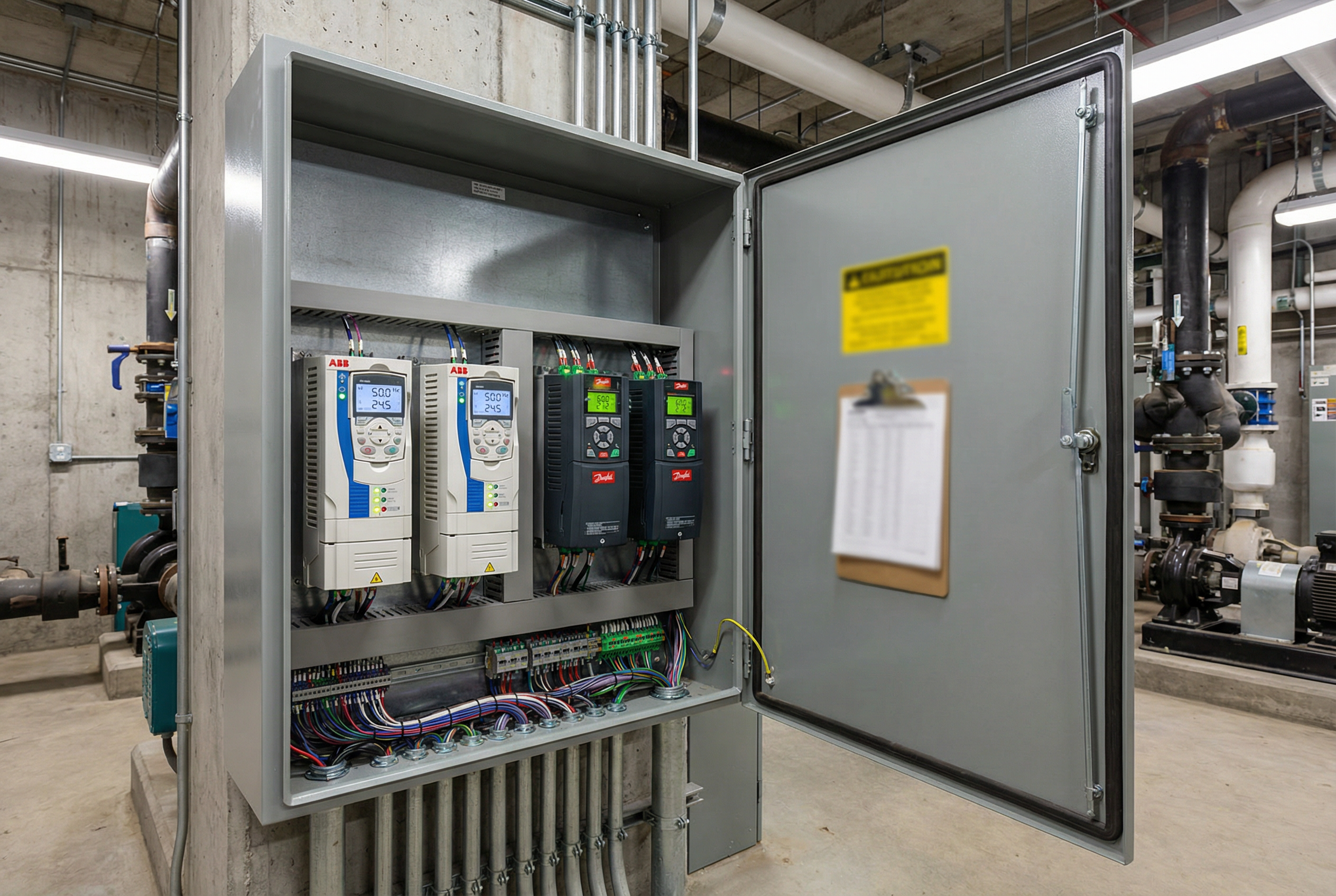
Every new chiller plant, every new air handler, every new cooling tower — VFDs on everything. And that's great. The energy savings from variable speed operation are real and significant. But I keep walking into buildings where they spent $50,000 on VFDs and then set the minimum speed to 70% because "the system doesn't work below that."
That's not a VFD problem. That's a system design problem. And you just spent $50,000 to save 30% of the energy you could be saving.
What You're Seeing
Your VFDs are installed and running. The building is comfortable. But your energy savings aren't matching the projections from the engineer's report. The drives are running, but they're running at 85-95% speed most of the time. They ramp down a little at night and on weekends, but during occupied hours they're basically at full speed.
Or maybe the VFD is hunting — ramping up and down constantly, never settling at a steady speed. The motor sounds like it's having an argument with itself.
What It Usually Means
The affinity laws are your best friend. For centrifugal loads (fans and pumps), power is proportional to speed cubed. Let me say that again because it's the most important equation in HVAC energy efficiency:
Power = Speed³
Reduce a fan from 100% to 80% speed and power drops to 51%. Reduce to 60% speed and power drops to 22%. That cubic relationship is why VFDs have such fast paybacks — but only if you actually let them slow down.
If your VFD can't go below 70-80% speed, the problem is usually:
Minimum flow requirements. Some systems have minimum flow requirements that prevent the pump from slowing down. This is common in primary-only chiller plants where the chiller needs minimum flow through the evaporator. The solution is usually a minimum flow bypass valve, not a high minimum speed.
Control instability. The VFD is hunting because the control loop isn't tuned properly. The PID gains are too aggressive, or the sensor is in a bad location, or there's too much dead time in the system. Slow down the control loop and the hunting stops.
Undersized ductwork or piping. If the system was undersized to begin with, the VFD can't slow down because the system needs full speed just to meet load. This is a design problem, not a VFD problem.
What to Check
Check your minimum speed setting. What is it and why? If someone set it to 70% "because it didn't work below that," find out why it didn't work and fix the root cause. Every percentage point of minimum speed you can reduce is real energy savings.
Check your control loop. Is the VFD responding to the right signal? A chilled water pump should be controlled by differential pressure, not flow. A supply fan should be controlled by duct static pressure, not discharge temperature. Wrong control signal = poor performance.
Check for static pressure or differential pressure reset. If your fan VFD is maintaining a fixed 1.5" static pressure setpoint 24/7, you're wasting energy during low-load periods. Implement static pressure reset — reduce the setpoint when VAV boxes are mostly satisfied and increase it when boxes are starving. Same concept for pump DP reset.
Listen to the motor. VFDs produce harmonics that can cause audible motor noise. If the motor is screaming, the carrier frequency might be too low. Bump it up to 4-8 kHz for most HVAC applications. Just know that higher carrier frequencies mean slightly more heat in the drive, so check the drive temperature after adjusting.
Common Mistakes
Running the VFD in hand/bypass mode permanently. I see this more than you'd think. Someone had a problem with the drive, couldn't figure it out, and put it in bypass "temporarily." That was three years ago. The drive is there, it's powered up, but the motor is running across-the-line at full speed. You're paying the electric bill for a VFD that isn't doing anything.
Not accounting for harmonics. VFDs create harmonic distortion on the electrical system. One or two small drives? Not a big deal. Twenty drives on the same bus? You might have a harmonics problem. Symptoms include overheating transformers, nuisance breaker trips, and interference with sensitive equipment. Line reactors or harmonic filters can help.
Oversizing the VFD. "Let's go one size up for safety." Now your drive is running at 40% capacity, which is less efficient than a properly sized drive at 80% capacity. Size the drive for the motor, not for your anxiety.
Field Notes
Best VFD story I have: walked into a chiller plant with three 100 HP chilled water pumps, all on VFDs. The drives were set to minimum 85% speed. The building engineer said "they hunt below 85%." I looked at the control loop — the DP sensor was installed right next to the pumps, about 10 feet from the pump discharge.
That's like measuring the water pressure right at the fire hydrant and wondering why the houses down the street don't have enough pressure. Of course the DP is satisfied right next to the pumps — the resistance hasn't even started yet.
Moved the DP sensor to the most remote coil in the building. Retuned the PID loop. The pumps now run at 45-65% speed during normal operation. Energy savings on those three pumps alone: about $28,000 per year.
The sensor move took two hours. The payback was about three days.
That's the kind of stuff that makes this job fun. You don't always need new equipment. Sometimes you just need to put the sensor in the right place.
Frequently Asked Questions
How much energy do VFDs save in HVAC?
For centrifugal loads like fans and pumps, power is proportional to speed cubed. Reducing speed from 100% to 80% cuts power consumption by nearly 50%. Actual savings depend on load profile, but 30-60% energy reduction is typical for properly applied VFDs.
Why does my VFD hunt or oscillate?
VFD hunting is usually caused by an improperly tuned PID control loop, a sensor in a poor location, or too much dead time in the system. Slow down the control response (reduce proportional gain, increase integral time) and verify the sensor is in a representative location.
What Is Static Pressure in Commercial HVAC? A Field Tech's Guide to Measuring It Right
11 min read
RTU Economizer Not Working? Here's Why 60% of Them Fail (And How to Fix Yours)
10 min read