Quick Answer
Your Building Automation System (BAS) is probably lying to you. Not because the sensors are junk or the software is buggy, but because it's been set up to fail from day one. To get real performance and energy savings out of your building's brain, you have to stop trusting the pretty graphics on the screen, enforce military-grade standards for how your points are named and programmed, and actually create a workflow to fix the problems the system is screaming about.
The Setup
I’ve been doing this since I was a kid handing my dad tools, and I can tell you the biggest change in our trade isn’t the refrigerants or the boiler designs—it’s the computers. We went from pneumatic controls that you could literally hear working to digital controllers that run entire skyscrapers. The problem is, we’re installing Formula 1 engines and then driving them like we’re stuck in city traffic.
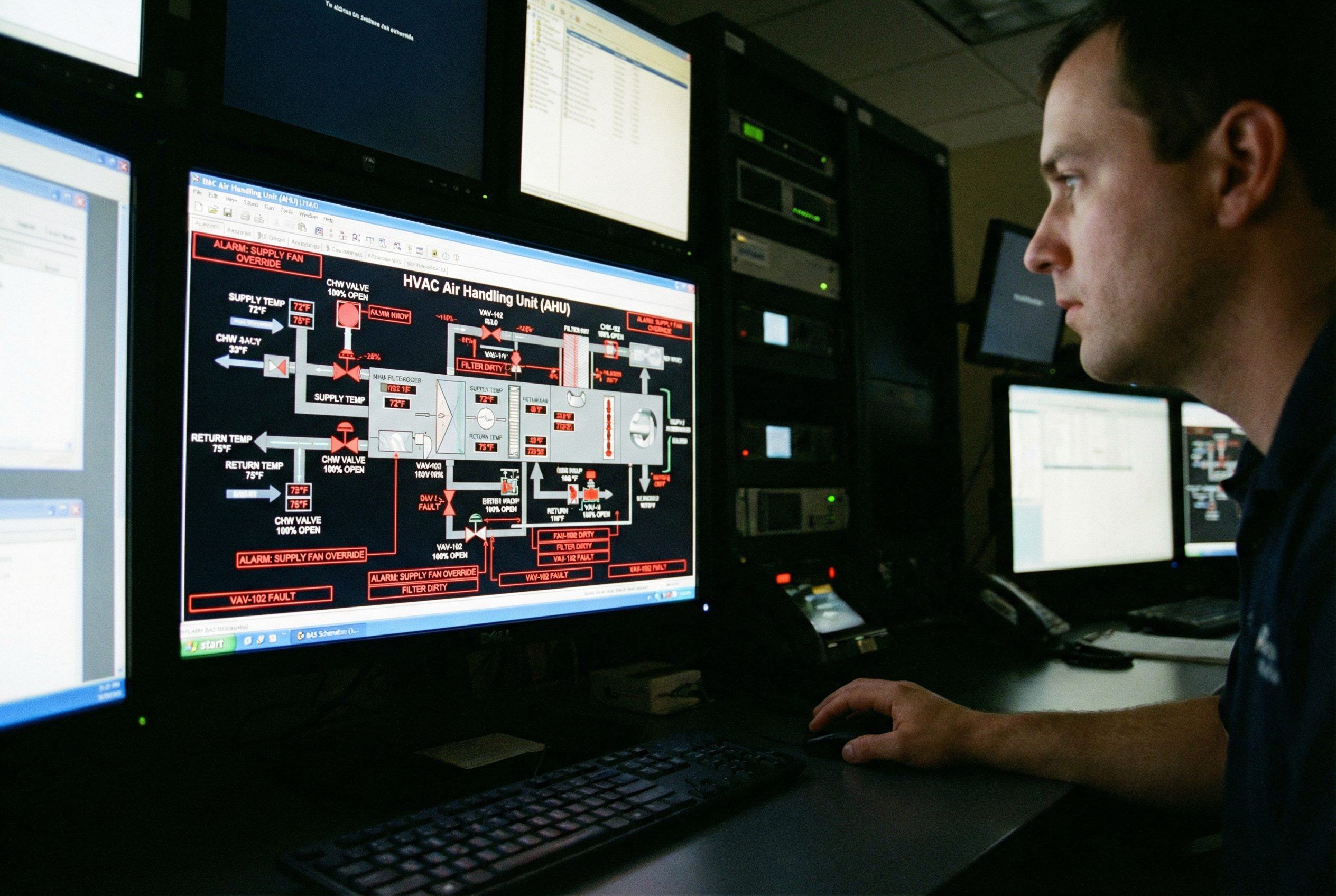
I remember this one job at a big data center. They had this state-of-the-art BAS, millions of dollars in hardware, and their PUE (Power Usage Effectiveness) was still terrible. The facility manager was pulling his hair out. He showed me the BAS screen, and everything was green. All systems go. But you could walk into the data hall and feel hot spots, hear servers whining. The BAS was happy as a clam, but the building was not.
That’s the core of the problem. We’ve gotten so good at installing these complex systems that we’ve forgotten how to actually use them. We treat the BAS as the finish line, when it’s really just the starting gun.
What You're Seeing (The Symptoms)
If your BAS is lying to you, it shows up in a few classic ways. You’re not going to get a big flashing alarm that says “I’m making things up!” Instead, you see the symptoms in the building and on your utility bills.
First, you get the classic “mystery complaints.” The BAS says the conference room on the 12th floor is a perfect 72°F, but the executive who works in there is complaining it’s an icebox. You check the screen, see the green number, and tell them it’s fine. But it’s not fine. The sensor is probably reading the temperature of the air right next to a drafty window, not the air where the people are.
Second, your energy bills are creeping up, even though the BAS is supposedly running its “optimized” schedule. This is what I call “set-and-forget drift.” The system was commissioned, maybe even retro-commissioned, but over time, overrides were put in, schedules were changed for a one-off event and never changed back, and now your building is basically running 24/7. I’ve never met a BAS override that expired on its own.
Finally, you have a complete breakdown of trust between the operators and the system. Your guys stop looking at the BAS for real information. They know the chilled water return temperature sensor is off by 5 degrees, so they just do the math in their head. They know the CO2 sensor in the main lobby is junk, so they ignore it. The BAS becomes a glorified digital clock, not a tool.
What’s Actually Going On (The Technical)
So, what’s happening under the hood? It’s usually a mix of three things: bad data, protocol wars, and no one owning the damn thing.
First, the data itself. A BAS is only as smart as the information it gets. If a sensor is out of calibration, installed in the wrong place, or just plain broken, the entire control loop is working with bad intel. It’s garbage in, garbage out. The BAS will happily run a chiller at 100% to satisfy a faulty sensor reading 80°F in a room that’s actually 68°F. The system is doing its job perfectly based on the data it has—the data is just a lie.
Then you have the protocol wars. You’ve got BACnet, Modbus, LonWorks… all these “open” protocols that are supposed to let everything talk to each other. But “open” doesn’t mean “easy.” I’ve spent countless hours on job sites trying to get two BACnet systems to play nice. The problem is that the protocol is just the language; it doesn’t control the vocabulary. If one system calls the zone temperature Zn_Temp and another calls it ZoneTemp, they might as well be speaking different languages. Without a brutally enforced, consistent naming convention, your integrated system is just a collection of devices yelling at each other.
Finally, and this is the big one, there’s no clear ownership. The mechanical contractor installs the VAV box. The controls contractor pulls the wire and mounts the thermostat. The BAS vendor programs the front end. When the executive’s office is cold, who gets the call? Everyone points fingers. The controls guy says the VAV damper is stuck. The mechanical guy says the controls are telling it to close. The BAS vendor says their sequence is running as designed. This is where having a single point of responsibility, a true Master Systems Integrator, is critical.
What to Check First (Troubleshooting)
When you’re faced with a lying BAS, don’t just start swapping out sensors. You need a systematic approach.
-
Trust, but Verify (with a good thermometer): Before you believe any number on the screen, go to the space with a calibrated thermometer. I mean a real, high-quality digital thermometer. See what the actual temperature is. If the BAS says 72°F and your thermometer says 78°F, you’ve found your first problem. Do this for a few key points—a problem zone, a main discharge air temp, a chilled water line. This tells you if you have a sensor problem or a system problem.
-
Play Detective with the Trend Logs: The trend log is your best friend. Don’t just look at the live value; look at the history. Is that sensor reading flat-lined? It’s probably dead or overridden. Is it swinging wildly? Maybe it’s loose or getting interference. I once chased a ghost in a system for a week until I saw the trend log for a pressure sensor was perfectly in sync with the elevator’s movement. The electrical interference was throwing it off every time the elevator ran.
-
Read the Sequence of Operations: This is the document that nobody reads. The sequence of operations is the instruction manual for your building. It tells you exactly what the system is supposed to do. For example, it might say, “When the zone temperature is 2°F above setpoint, the VAV damper will modulate open.” If you see the damper is closed but the temperature is high, you can work backward. Is the BAS commanding it to be closed? If so, why? Is the command being sent but the actuator isn’t responding? Now you’re getting somewhere.
-
Check for Overrides: Hunt down overrides like you’re a detective looking for clues. In most systems, you can search for any point that’s been manually forced. You'll almost certainly find some. A supply fan that was forced on for an after-hours event three months ago. A chilled water valve that was forced open to stop a hot call and never released. These are the silent killers of efficiency.
The Numbers That Matter
When you’re trying to prove your BAS is lying, you need to bring data to the fight. Here are the numbers that actually matter:
-
5% to 25%: That’s the range of annual energy savings you can get from system “retuning” or retro-commissioning. This isn’t about new hardware; it’s about fixing the operational problems and bad programming that have crept into your system. It’s the cheapest energy savings you’ll ever find.
-
9%: This is the median energy savings from a properly implemented Fault Detection and Diagnostics (FDD) program. But here’s the catch: the software doesn’t save you a single watt. The savings come from actually acting on the faults it finds. An insight without action is just expensive data.
-
$0.06/ft²: That’s a typical base cost for FDD software. It’s not free, but when you compare it to the savings, the payback can be fast. We worked with a retail chain that rolled out a BMS and analytics program across 700 stores and saw an average of 11% whole-building energy savings. The numbers are real if you do the work.
-
30%: Buildings account for about 30% of global energy consumption. We’re on the front lines of one of the biggest energy problems in the world. Getting the BAS right isn’t just about saving a few bucks; it’s about our responsibility as professionals.
What I've Learned (Field Wisdom)
Here’s the thing they don’t teach you in a certification class. The success of a BAS project has almost nothing to do with the brand of controller you use or the protocol it speaks. It’s all about discipline and process.
I’ve seen this more times than I can count: a building owner spends a fortune on a new system, and a year later, it’s a mess. Why? Because they never created a rulebook. You need a written standard for everything. How will you name your points? Who has the authority to make a change to a sequence? How are overrides tracked and, more importantly, removed? If it’s not written down, it doesn’t exist.
Another thing I’ve learned is that cybersecurity in our world is no longer optional. We’re connecting everything to the internet, and a lot of the time, we’re doing it with the security equivalent of a screen door on a submarine. Exposing a BAS supervisor directly to the public internet is just asking for trouble. We had a client whose system was compromised; the hackers weren't trying to steal data, they were just messing with the system for fun, changing setpoints, turning off fans. It caused chaos for days. You have to segment your network and treat the OT (Operational Technology) network like the critical system it is.
The best BAS in the world is useless if the operators aren't trained. I don’t mean a one-hour PowerPoint presentation on handover day. I mean real, hands-on training. The guys in the field are the ones who will make or break your system. If they don’t understand the why behind a sequence, they’ll just override it. If they don’t trust the data, they’ll ignore it. Invest in your people as much as you invest in your hardware.
The Bottom Line
Your BAS isn’t a magic box. It’s a powerful tool that requires skill, discipline, and constant attention. Stop blaming the hardware and start looking at your process. The graphics on the screen might look nice, but the real story is in the trend logs, the utility bills, and the comfort of the people in the building.
Next time you walk into a mechanical room and see a BAS screen full of green lights, ask yourself: Is this the truth, or is it just a pretty picture? Go out into the building, take some real measurements, and find out for yourself. The best tool in your bag is still a healthy dose of skepticism and a good thermometer.
Frequently Asked Questions
What is the main takeaway from this article?
Your Building Automation System (BAS) is probably lying to you. Not because the sensors are junk or the software is buggy, but because it's been set up to fail from day one. To get real performance an

BACnet Troubleshooting for HVAC Techs: IP Addresses, MS/TP Wiring, and Network Basics
9 min read
VFD Not Saving Energy? How to Actually Optimize Variable Frequency Drives in HVAC
11 min read