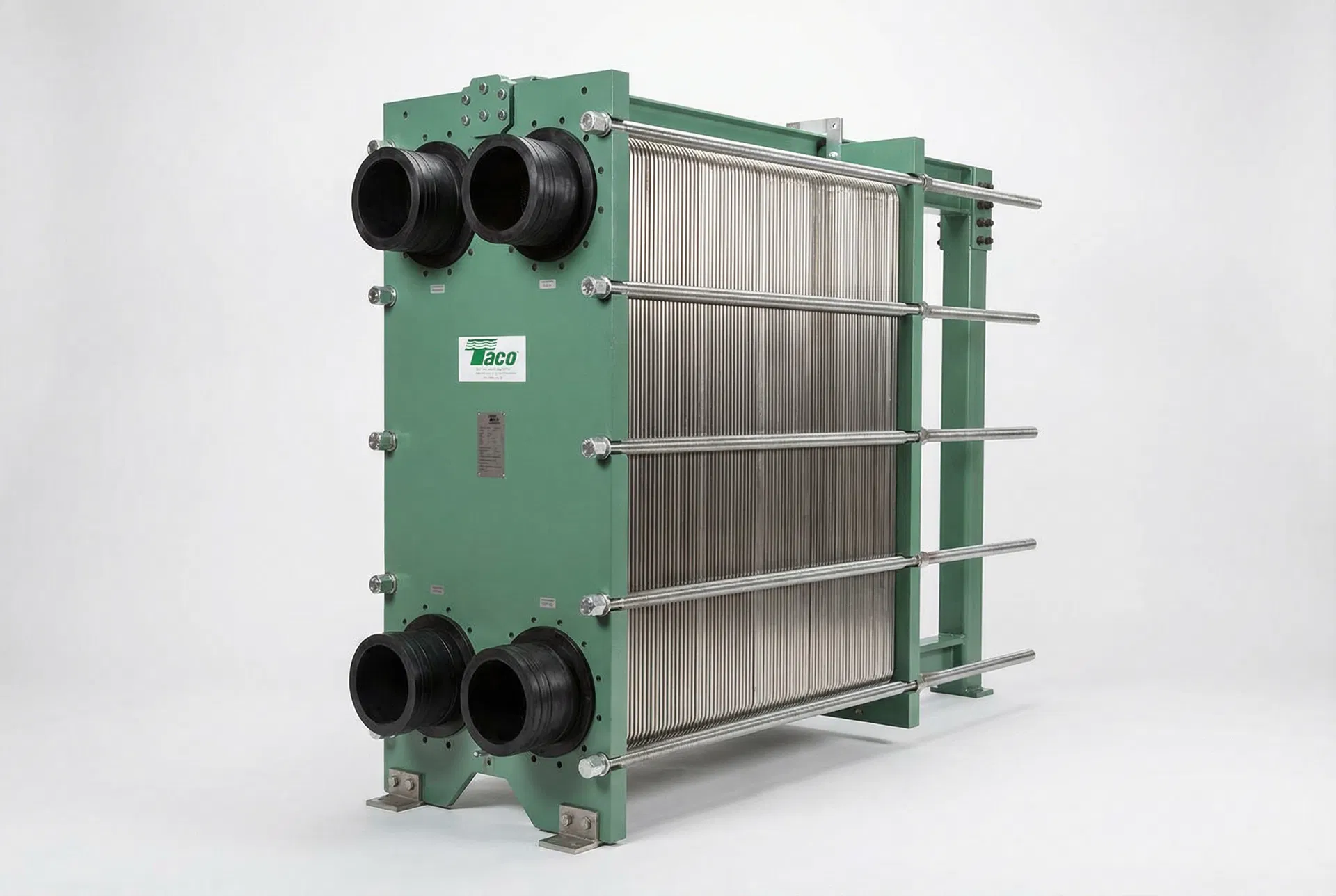
Plate heat exchangers are one of those things that work beautifully until they don't. And when they don't, it's usually at the worst possible time. I've been called out on more emergency plate HX failures than I can count, and they almost always could have been prevented with basic monitoring and maintenance.
What You're Seeing
Scenario 1: Rising approach temperatures. Your plate HX used to give you a 2°F approach and now it's 8°F. The secondary side can't keep up. You're compensating by running more equipment downstream.
Scenario 2: Pressure drop is climbing. Your differential pressure across the HX has doubled since commissioning. Flow is restricted and you're starving the secondary loop.
Scenario 3: You found water where water shouldn't be. Congratulations, you have a leak. And if it's a brazed plate HX, your options just got very limited and very expensive.
What It Usually Means
Fouling. This is the number one killer of plate heat exchangers. Those narrow channels between the plates are incredibly efficient at transferring heat — and incredibly efficient at collecting scale, debris, and biological growth. A plate HX with 3mm channels doesn't need much fouling to lose serious performance.
The type of fouling depends on your system. Cooling tower water side? You're looking at calcium scale and biological growth. Closed loop? Probably corrosion products and magnetite if someone neglected the water treatment. Steam-to-water? Scale from the feedwater side.
Gasket failure (on gasketed plate HX). Gaskets deteriorate over time, especially with temperature cycling. When they fail, you get cross-contamination between the primary and secondary sides, or external leaks. I've seen glycol show up in domestic hot water systems because a plate HX gasket failed. That's a bad day for everyone.
Freeze damage. If someone let the secondary side of a plate HX freeze — and I've seen this happen more times than you'd think — those plates are warped and done. Brazed plates especially. You can't fix freeze damage. You're buying a new core.
What to Check
Log your approach temperatures. This is the single most important thing you can do. If you're trending approach temps monthly, you'll see fouling developing long before it becomes an emergency. I keep a simple log: date, primary in/out, secondary in/out, flow rates. Takes five minutes.
Check your pressure drops. Compare current DP to commissioning data. If it's more than 50% higher, you need to clean or investigate.
Look at your water treatment. Is the treatment program being maintained? When's the last time someone tested the water? If the answer is "I don't know," that's your problem right there.
Inspect gaskets (if gasketed type). Look for weeping, discoloration, and hardening. Gaskets have a finite life — typically 8-10 years depending on conditions.
Common Mistakes
Not having isolation valves. I can't tell you how many plate HX installations I've seen with no isolation valves. How are you supposed to service it? Drain the whole system? Put isolation valves on both sides, primary and secondary. It's cheap insurance.
Cleaning with the wrong chemicals. Acid cleaning a plate HX sounds simple, but use the wrong acid concentration or leave it in too long and you'll eat through the plates. Always follow the manufacturer's cleaning procedure. And for the love of God, don't use muriatic acid from Home Depot. Use proper descaling chemicals.
Ignoring the strainer. There should be a strainer upstream of every plate HX. If there isn't, install one. If there is, when's the last time someone cleaned it? I pulled a strainer on a plate HX last year that was 90% blocked. The customer's complaint was "the heat exchanger doesn't work." No, the heat exchanger works fine — you just weren't letting any water get to it.
Field Notes
Here's a fun one. Got called to a high-rise in Manhattan — their domestic hot water was lukewarm at best. Building manager was ready to replace the plate heat exchanger. $45,000 job. I checked the approach temps and they were terrible — like 15°F on a unit that should be doing 3°F. But before I condemned the HX, I checked the strainer.
Pulled it out and it was packed solid with what looked like black sludge. Turns out the building had done some piping work six months earlier and never flushed the system properly. All the cutting oil, pipe dope, and debris settled right into the strainer. Cleaned the strainer, flushed the system, approach temps dropped back to 3°F. Total cost: about two hours of labor and a new strainer gasket.
The $45,000 heat exchanger was fine. It just needed someone to actually look at the whole system instead of jumping to the most expensive conclusion.
That's the job, though. Half of what we do is figuring out what we DON'T need to replace.
Frequently Asked Questions
How do you know if a plate heat exchanger is fouled?
The two main indicators are rising approach temperatures (the difference between primary and secondary outlet temps) and increasing pressure drop across the HX. Compare current readings to commissioning data — if approach temps have doubled or pressure drop is 50%+ higher, fouling is likely.
Can you repair a brazed plate heat exchanger?
Generally no. Brazed plate HX units cannot be disassembled for cleaning or gasket replacement. If a brazed unit develops internal leaks or severe fouling that chemical cleaning can't resolve, the entire core must be replaced.
How often should plate heat exchangers be cleaned?
It depends on water quality and treatment. With good water treatment, every 2-5 years. With cooling tower water or poor treatment, annually or more. The best approach is to trend approach temperatures monthly and clean when performance degrades beyond acceptable limits.
Chiller Plant Running All Chillers on a Mild Day? Low Delta-T Explained
10 min read
Boiler Water Treatment 101: The $8,000/Year Program That Saves You $65,000 in Repairs
10 min read