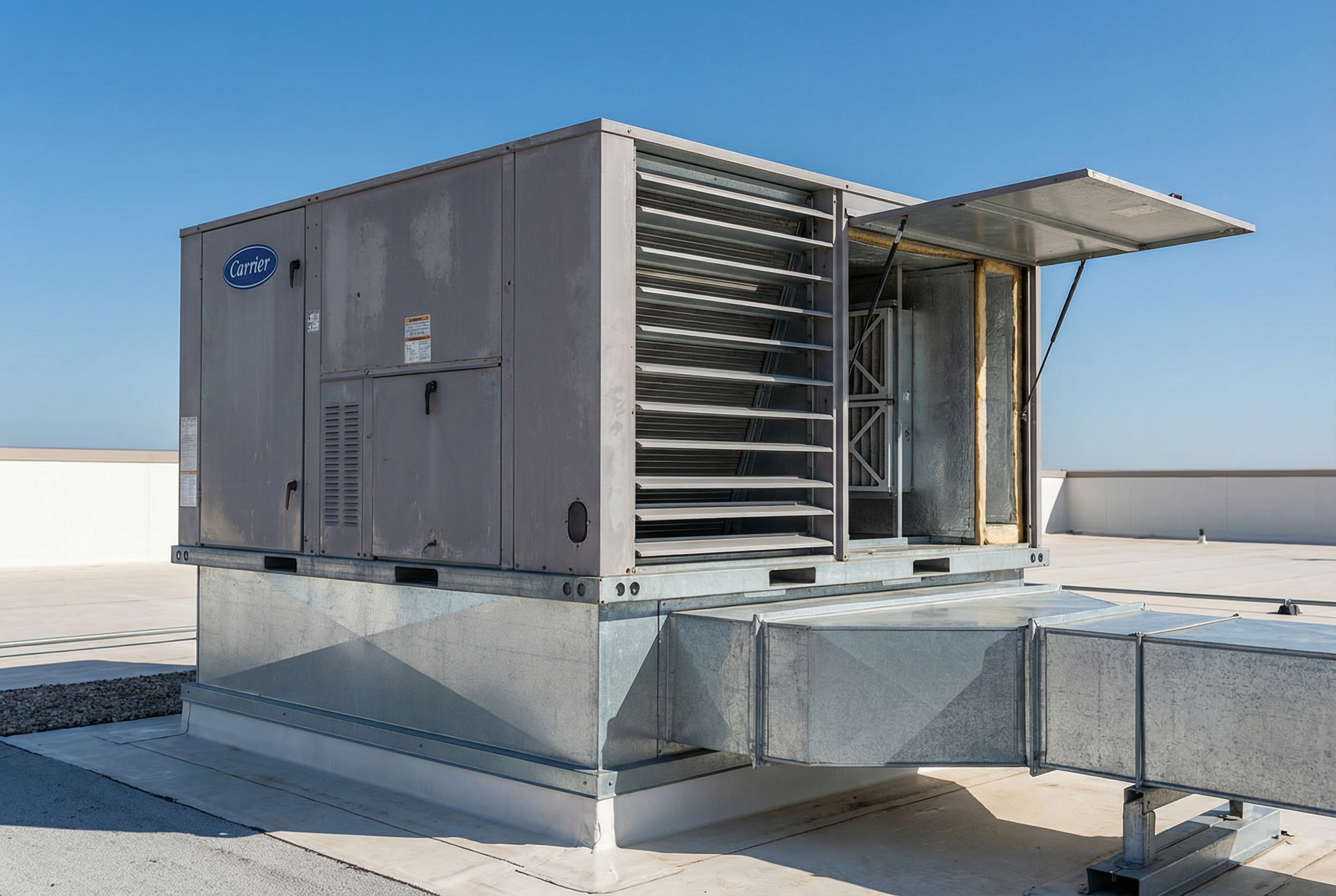
Economizers are the best deal in commercial HVAC — when they work. Free cooling! Just use outside air instead of running the compressor! What could go wrong?
Everything. Everything can go wrong. And it usually does.
Industry studies consistently show that 50-70% of economizers in the field are not functioning correctly. That means more than half the rooftop units in this country are wasting energy because nobody bothered to check if the economizer actually works. It's like having a coupon for free groceries and leaving it in your pocket every time you go to the store.
What You're Seeing
It's a beautiful 55°F day. Perfect economizer weather. But your RTU is running the compressor at full tilt. The outdoor air damper is barely cracked open. You're paying for mechanical cooling when Mother Nature is offering it for free.
Or the opposite: it's 95°F outside and the outdoor air damper is wide open, dumping hot humid air into the building. The compressor is running nonstop trying to overcome the extra load. Your energy bill looks like a phone number.
What It Usually Means
Stuck dampers. This is number one, and it's not even close. Damper actuators fail, linkages break loose, damper blades corrode in position. I've seen economizer dampers that haven't moved in years. The actuator is commanding them to open and close, but the blades are rusted solid. The BAS shows "economizer active" but the damper is laughing at it.
Failed sensors. Outdoor air temperature sensors take a beating from weather. Return air sensors get coated in dust. Mixed air sensors get installed in locations where they can't read a true blend. One bad sensor and the whole economizer logic falls apart.
Wrong changeover setpoint. Many economizers are set to a fixed dry-bulb changeover of 55°F. That's way too conservative for most climates. You're leaving hundreds of hours of free cooling on the table. ASHRAE 90.1 allows changeover up to 75°F dry-bulb in many climate zones. Raising that setpoint from 55°F to 70°F can add 500+ hours of free cooling per year.
Minimum outdoor air not set. Even when the economizer is in mechanical cooling mode, you need minimum outdoor air for ventilation. If minimum OA is set to 0%, you're recirculating stale air and violating code. If it's set too high, you're bringing in more outdoor air than you need and wasting energy.
What to Check
Here's my systematic approach. I do this on every RTU I touch:
1. Full stroke test. Command the economizer damper full open. Watch it move. Command it full closed. Watch it move. If it doesn't move, nothing else matters. Fix the damper first.
2. Verify sensors. Put a calibrated thermometer next to every sensor — outdoor air, return air, mixed air. If any sensor is off by more than 2°F, replace it. Don't try to offset it in the controller — replace the sensor. Offsets are band-aids.
3. Check changeover setpoint. What's it set to? Is it appropriate for your climate zone? If it's at 55°F, you're probably leaving money on the table.
4. Verify minimum OA position. With the economizer in minimum position, measure the outdoor air percentage using the mixed air temperature method: %OA = (MAT - RAT) / (OAT - RAT) × 100. Compare to your ventilation requirement.
5. Watch it operate. On a day when conditions are right for economizer operation, watch the system for 30 minutes. Does the damper modulate smoothly? Does the mixed air temperature track the setpoint? Does it stage properly with mechanical cooling?
Common Mistakes
Assuming the BAS is telling the truth. The BAS says "economizer enabled" and "damper at 75% open." Great. Go up to the roof and verify. I can't count how many times the BAS said one thing and reality said another. The BAS only knows what the sensors and actuators tell it. If the actuator is disconnected, the BAS has no idea.
Not checking the barometric relief. When you bring in more outdoor air, that air has to go somewhere. If the building doesn't have adequate relief — either barometric dampers or a relief fan — the building pressurizes, doors won't close, and the economizer can't bring in the air it needs. Check the relief path.
Seasonal neglect. Economizers get checked in the fall when everyone's thinking about heating season. Then they sit all winter. Come spring, the damper is stuck, the sensor is dead, and you've missed the best economizer weather of the year. Check them in early spring too.
Field Notes
Best economizer story I have: office building in Midtown, twenty RTUs on the roof. Building manager complained that energy costs were way too high for the building size. I went up to the roof and did a full stroke test on every unit. Out of twenty economizers, seventeen were not functioning. Eleven had stuck dampers, four had failed sensors, and two had been manually locked out by a previous contractor who "couldn't get them to work right."
We fixed all seventeen over two weekends. The building's cooling energy dropped 35% the following month. Thirty-five percent. That's not a rounding error — that's real money.
The building manager asked why nobody had checked the economizers before. The answer is that nobody was paying attention. Economizers are out of sight, out of mind. They're on the roof, they don't generate alarms when they fail, and the building stays comfortable (just at a much higher cost).
Make economizer checks part of every PM visit. It's the highest-ROI maintenance task you can do on a rooftop unit. Period.
Frequently Asked Questions
Why do most economizers fail in the field?
The most common failure is stuck dampers from corroded blades, broken linkages, or failed actuators. Failed temperature sensors and incorrect changeover setpoints are also extremely common. Studies show 50-70% of field economizers are not functioning correctly.
What temperature should an economizer changeover be set to?
It depends on your climate zone, but many economizers are set too conservatively at 55°F. ASHRAE 90.1 allows changeover up to 75°F dry-bulb in many locations. Raising the setpoint can add hundreds of hours of free cooling per year.